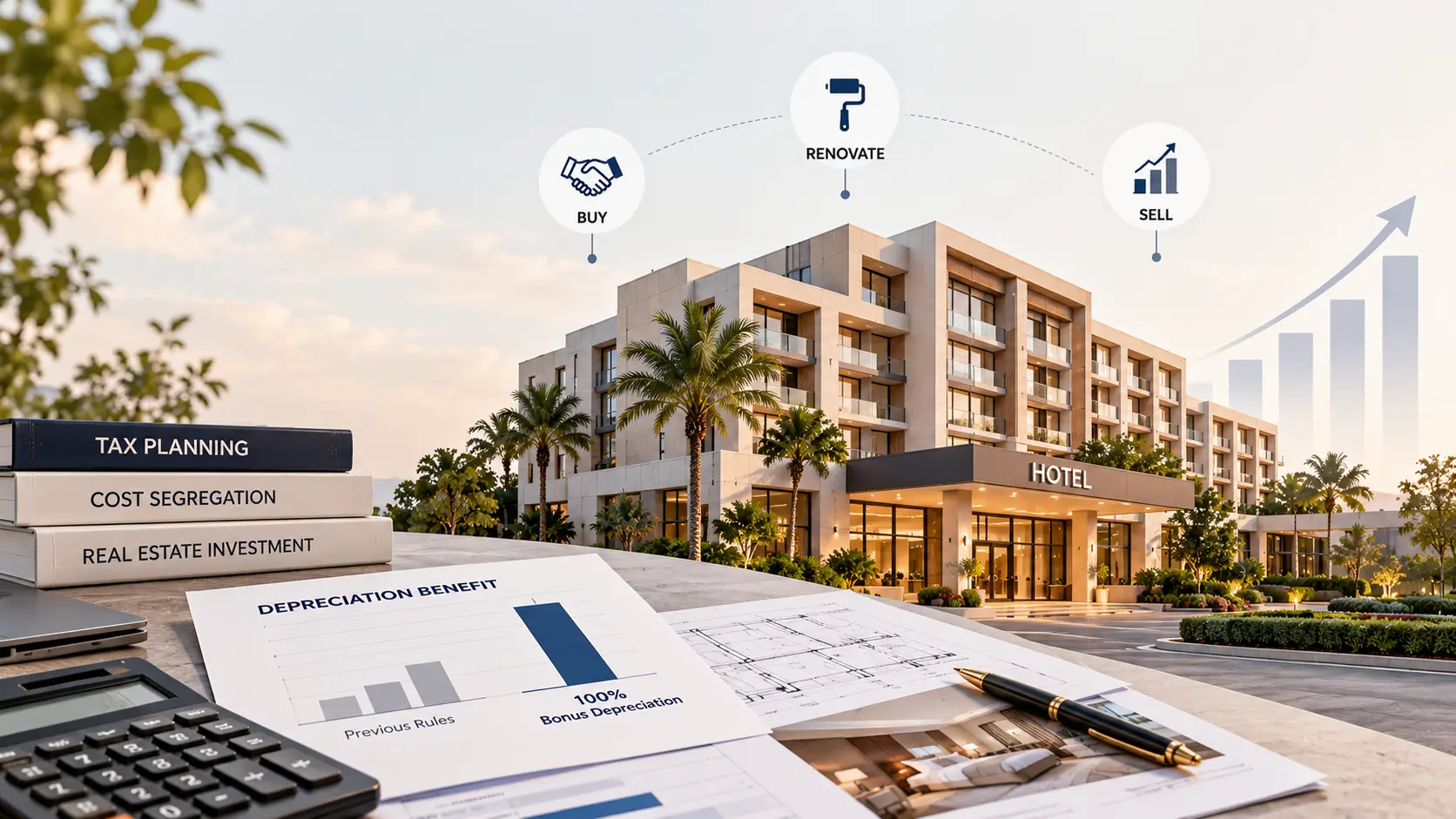
If you're planning to acquire a hotel, renovate an existing property, or prepare for a future sale, 2026 may look very different from what you expected just a year ago.
For years, hotel owners using cost segregation studies had to account for the gradual phase-down of bonus depreciation. The strategy still delivered value, but the window for maximizing deductions was getting smaller.
The OBBBA changed that.
With 100% bonus depreciation now permanently available for qualifying assets placed in service after January 19, 2025, hotel owners have a much larger opportunity to accelerate deductions and improve early-year cash flow. But the real value comes from understanding how this change affects decisions throughout the life of the property.
Let's break down what it means before you buy, renovate, or sell.
What Cost Segregation Actually Is
Most hotel properties are depreciated over 39 years.
On paper, that sounds straightforward. In reality, many of the assets inside and around a hotel don't last anywhere near that long.
Guest room furniture, carpeting, appliances, decorative lighting, parking lots, sidewalks, and landscaping all have different useful lives. A cost segregation study identifies these components and reclassifies them into shorter depreciation categories.
Typically, assets are grouped into:
- 5-year property, such as furniture, fixtures, equipment, and appliances
- 15-year property, such as parking lots, landscaping, and site improvements
- 39-year property, which remains the building structure
The benefit is simple. The faster an asset can be depreciated, the faster a business can claim tax deductions.
It's also important to understand that cost segregation isn't based on guesswork. A qualified engineering study provides the documentation needed to support the reclassification.
What Bonus Depreciation Does to the Numbers
This is where the OBBBA changes the conversation.
Before the law was enacted, bonus depreciation was scheduled to continue phasing down. In 2025, qualifying assets generally received only 40% bonus depreciation, with further reductions expected afterward.
Now, qualifying assets placed in service after January 19, 2025 may qualify for a full 100% first-year deduction.
The difference can be substantial.
Let's say a hotel acquisition includes $2 million of assets that a cost segregation study identifies as 5-year or 15-year property.
Under the previous rules, only $800,000 would have qualified for first-year bonus depreciation.
Under the current rules, the full $2 million may be deductible in year one.
For hotel owners generating strong occupancy and positive net operating income, that can create significant federal tax savings and improve available cash for operations, renovations, or future investments.
The Decision That Belongs at Acquisition, Not Year-End
One of the biggest mistakes owners make is waiting until tax season to think about cost segregation.
By that point, you're looking backward instead of planning forward.
A study performed shortly after acquisition captures the property's assets using the original purchase information and allocates values correctly from the beginning.
Yes, a study can still be completed years later through IRS-approved catch-up methods. But the process is often more complicated and may require additional analysis.
With permanent 100% bonus depreciation now available, the argument for evaluating cost segregation during the acquisition process has become much stronger.
In many cases, the cost of the study is small compared to the tax benefit it may generate during the first year of ownership.
Renovation: What Qualifies and What the TPR Election Means
Acquisitions aren't the only time these rules matter.
Hotel renovations can create valuable tax opportunities, but not every dollar spent receives the same treatment.
The IRS Tangible Property Regulations, often referred to as TPR, determine whether spending should be treated as a deductible repair or a capital improvement.
That distinction directly affects how quickly tax benefits are recognized.
There's another provision that many owners overlook: the partial asset disposition election.
When a hotel replaces major components such as roofs, HVAC systems, flooring, or guest room fixtures, it may be possible to write off the remaining tax basis of the assets being removed.
Combined with permanent bonus depreciation, this can make renovation projects far more tax-efficient than many owners realize.
The key is evaluating these opportunities before construction begins, not after the project is complete.
The Part Nobody Talks About: Section 1245 Recapture at Sale
Most conversations about cost segregation focus on the tax savings.
Very few focus on what happens when it's time to sell.
That's where Section 1245 recapture enters the picture.
Depreciation claimed on 5-year and 15-year property is generally recaptured at ordinary income tax rates when the property is sold.
For example, if an owner claims $2 million of bonus depreciation and later sells the hotel, that portion of gain may be taxed as ordinary income rather than at capital gains rates.
A typical hotel sale may involve three different categories of gain:
- Section 1245 recapture, taxed as ordinary income
- Unrecaptured Section 1250 gain, taxed at a maximum 25% rate
- Section 1231 gain, generally eligible for capital gains treatment
This doesn't mean cost segregation is a bad strategy. It simply means the tax impact of a future sale should be part of the conversation from the beginning. Owners who model both the acquisition and exit scenarios usually make better long-term decisions.
State Non-Conformity: The Federal Win That Doesn't Translate Everywhere
Federal tax savings don't always translate into identical state tax savings.
Several states, including California, New York, New Jersey, and Pennsylvania, do not fully conform to federal bonus depreciation rules.
As a result, hotel owners may receive the full federal deduction while being required to make adjustments on their state tax returns.
The benefit is still there, but it may not be as large as expected.
These differences can also require separate depreciation schedules for federal and state reporting purposes.
That's why state tax planning should be part of the discussion before returns are filed, not afterward.
Conclusion
Cost segregation has long been one of the most valuable tax planning tools available to hotel owners. With permanent 100% bonus depreciation now in place, the potential benefits have become even more attractive.
But successful planning goes beyond maximizing a first-year deduction.
The timing of an acquisition, the structure of a renovation, future sale considerations, and state tax treatment all play a role in the final outcome. The owners who gain the most value are the ones who look at the entire lifecycle of the property rather than focusing on a single tax year.
At GoalSeek, we help hotel owners, investors, and CPA firms navigate these decisions with cost segregation-informed depreciation schedules, hotel-focused tax planning, and accounting support designed to improve both short-term cash flow and long-term profitability.