The FICA tip credit under IRC Section 45B has been around since 1993. Most hotel owners know tips are part of payroll. Fewer realize that a portion of the employer tax paid on those tips can be recovered every year. There is no restructuring required. No entity planning. Just a credit that sits inside the return and is often not calculated correctly or not claimed at all.
In 2026, this matters even more. With hotel industry wages projected to approach $131 billion and tipped income continuing to grow across full-service properties, the size of this missed credit is increasing every year.
What the Credit Actually Is
Every time a hotel employee earns a tip, the employer pays FICA taxes on that income, at a rate of 7.65%. Section 45B allows food and beverage employers to recover the employer portion of FICA taxes paid on tips that exceed a specific wage threshold.
That threshold is where most people miss the detail. The minimum wage floor used in the calculation is not the current federal minimum wage of $7.25. It is frozen at $5.15 per hour, the rate in effect on January 1, 2007. That difference means a larger portion of tipped wages qualifies for the credit than most hotel owners assume.
The credit is claimed on Form 8846 and flows through Form 3800 as a general business credit. It is non-refundable, but it can be carried forward for up to 20 years, so even if a hotel doesn't use it immediately, it doesn't disappear.
What Qualifies as a Tip and What Does Not
Under IRS guidance, a qualifying tip must meet four conditions: the payment is voluntary, the customer decides the amount, the amount is not negotiated, and the customer decides who receives it. If any of these fail, it is not a tip.
That distinction is critical in hotels. A mandatory service charge, banquet fee, or automatic gratuity is not a tip. It is treated as wages, even if it is distributed to employees later. This is one of the most common misclassifications in hospitality payroll, and it creates a double problem: if service charges are incorrectly treated as tips, the credit is overstated; if real tips are misclassified as service charges, the credit is completely lost.
Why Form 8027 Drives Everything
For full-service hotels and restaurants, Form 8027 is not optional. It applies when there are more than 10 employees and food and beverage is served for on-premises consumption. It reports total tips reported, total charged tips, gross food and beverage receipts, and whether tips meet the 8% threshold. If reported tips fall below 8% of gross receipts, the employer must allocate the difference to employees as "allocated tips," which show up on W-2 forms.
This is where the FICA tip credit calculation begins. If Form 8027 is incorrect, everything downstream is incorrect.
What the Numbers Actually Look Like
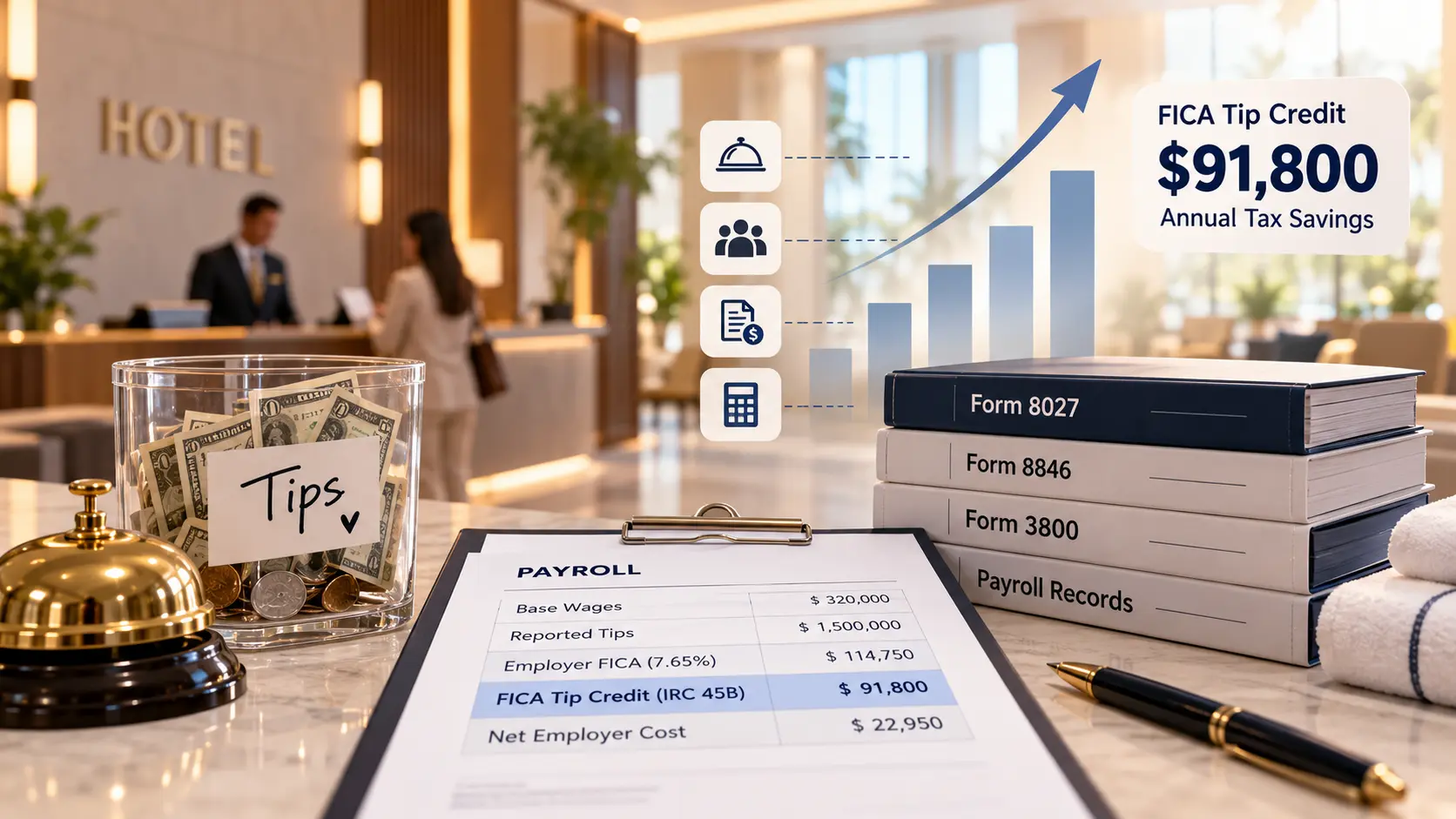
The rate is 7.65% on eligible tips above the $5.15 hourly floor. A hotel with 60 tipped employees earning an average of $25,000 in annual tips generates $1.5 million in total reported tips. After applying the wage floor adjustment, approximately $1.2 million may be creditable. At 7.65%, the annual credit is roughly $91,800. A larger full-service hotel with $3 million in tipped wages can generate $180,000 to $200,000 in annual credits.
This repeats every year the hotel has tipped income and the return is prepared correctly. It can also be recovered retroactively: amended returns allow claims for the past three years if the credit was missed.
Why Hotels Miss It
There are three common reasons. First, generalist tax preparers do not run the credit calculation as part of standard hospitality returns. Second, payroll systems often mix tips and service charges, making Form 8027 reconciliation incomplete or inaccurate. Third, many hotel owners are not aware the credit exists, so it is never requested.
Conclusion
The FICA tip credit is not complex. It does not require restructuring or tax planning strategies. It requires accurate payroll classification and a return prepared by someone who understands how hotel tip reporting actually works. In a year like 2026, where wages are rising and reporting systems are becoming more precise, the value of this credit is increasing, not decreasing.
At GoalSeek, we prepare hotel tax returns that include FICA tip credit calculations and Form 8027 reconciliation for hotel owners and the CPA firms that serve them.